

What is a chapbook?
And why you might want to write one
A Brief (and fascinating!) History of the Chapbook
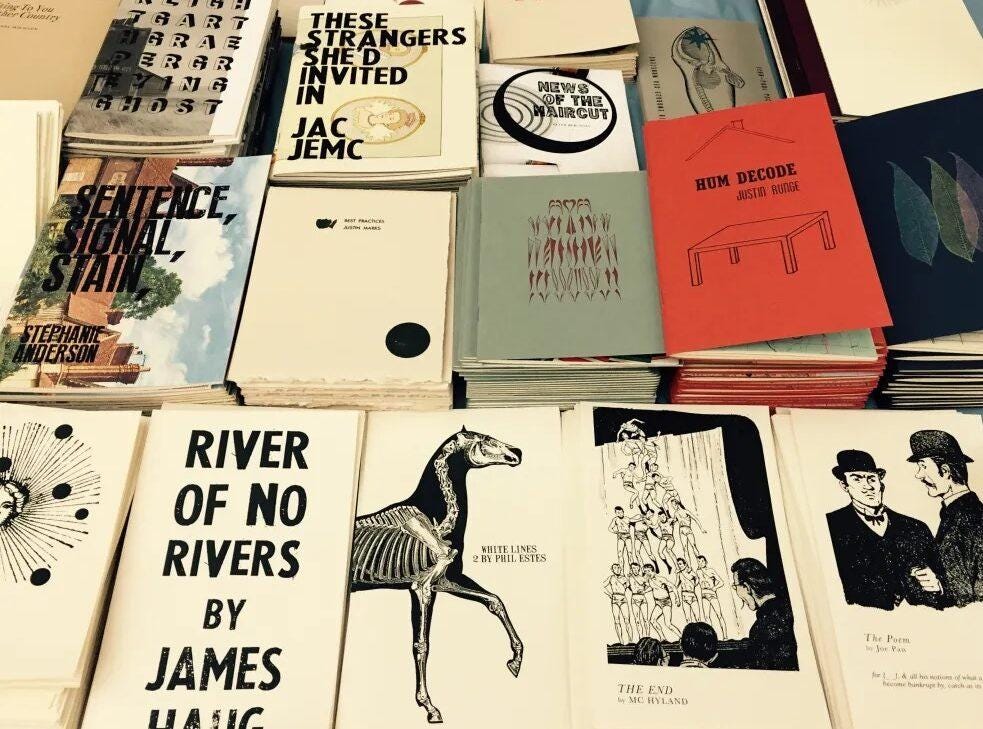
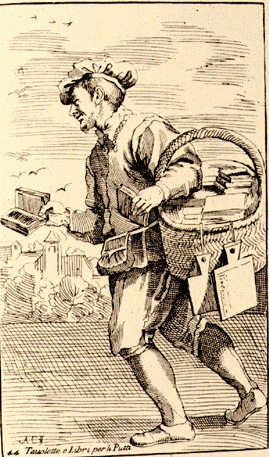
16th Century Europe
In an age when many people were illiterate, chapbooks were sold by chapman, which is an old term for a peddler who traveled on foot selling cheap printed matter like ballads, almanacs, fairy tales, erotic stories, religious warnings, and folk medicine.
Small enough to fit in a pocket and cheap enough to buy with a few coins, chapbooks were printed on single sheets of paper, folded and stitched into 8, 12, or 16 pages, and sold by the thousands. They were usually coverless, illustrated with reused woodcuts (which often had nothing to do with the content of the books - think random clipart from the 90’s), and read aloud in kitchens, taverns, fields, and workhouses.
They were the people’s literature; populist, subversive, often bawdy, and entirely outside the elite literary canon.
“The creators of chapbooks have always been concerned with circumventing the official channels by which writing is allowed to make itself available to a public.” - Erica Van Horn
Eventually, preachers and moral philosophers began to use these pamphlets as a place for moral treatises. “This led to a proliferation of religious chapbooks, often called ‘Sunday schools’ or ‘godlinesses’, which aimed to bolster the moral fiber of the plebeian masses whom the racier strand of chapbooks had previously entertained.”* For very understandable reasons, the chapbook fell out of favor for a long time.
Fast-forward to the late 19th and early 20th century,
The chapbook resurfaced, this time aligned with the Arts and Crafts movement. The context for the books was different, but the impulse was similar: to create work that existed outside of mass production, cheapening aesthetics, and the alienation of modernity. (Do you see why I’m bringing this up now?)
Writers and bookmakers sought to return to traditional methods like letterpress, hand-stitching, and textured paper. Their goal now was to elevate the small book into a work of art and by then the genre of the chapbook had shifted.
While the original chapbooks told epic, sometimes ridiculous tales, now the chapbook was primarily poetic.
*If you’re curious, you can read more here: A Very Short History of the Chapbook – Middlebury College
The Chapbook Today
Today, many small presses hold contests for chapbooks, publishing the winners and sometimes the runners up as well. There is often a small cash prize, but the real prize is seeing your work in print.
Which brings us to you — and to now.
Today’s chapbooks still exist at the margins. They are usually too small to profit from and too strange to fit easily into the literary marketplace. And I think that’s part of their magic! Their brevity allows for experimentation, for obsession, and for writing that doesn’t fit anywhere else.
So, why might YOU want to write one?
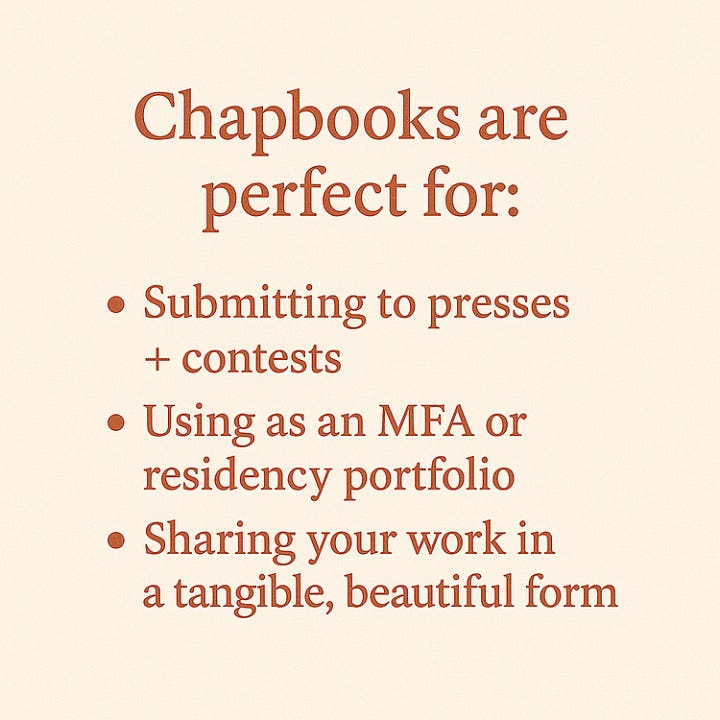
to hone your voice and create something beautiful
to apply to MFA programs and residencies
to submit to chapbook contests (a great way to get some visibility and publications)
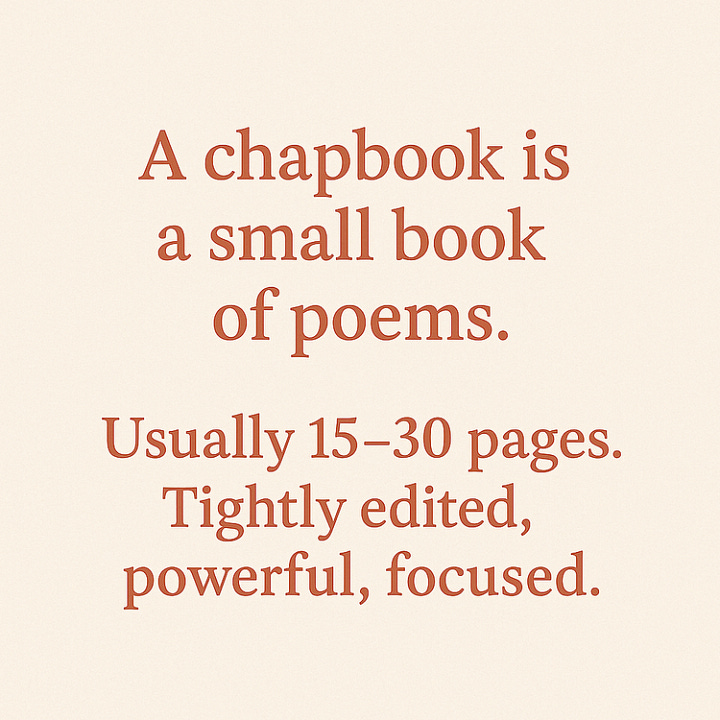


Beginning to envision the book you want to put together
Chapbooks can take many forms, physical or digital.
A chapbook might be:
A hand-bound zine of poems, photocopied and stapled
A PDF designed in Canva and shared with your community.
A serialized collection of poems on Substack.
A single handmade object
or a collection of poems you submit to small presses
Regardless of the form it takes, the goal of a chapbook is to bring together a small body of work into a shared shape.
Journal Prompts
What are you always circling in your work?
Where are your internal contradictions? Places where your words and actions misalign?
What questions, ideas, or memories won’t leave you alone?
How might this project be oriented in time and space — to yourself, other writers, thinkers, ancestors, or movements?
Want to dive into creating a chapbook this summer? You can grab my self-paced email course, “Chapbook Studio” here. This is a version of my five-week class from last summer, designed to be done at your own speed. Over 5 days, you’ll receive 5 emails with prompts for compiling, editing, naming, and designing your own chapbook (this email is an excerpt from the first day to give you an idea of the structure and content. The full email has even more prompts and exercises to get you visioning the book)
(paid subscribers can get $25 off with a coupon code I will post in the paid group chat)
Happy writing!
Alix
Coming up today (June 13th) at 3pm Eastern - upgrade now to join us! (Zoom link can be found below the paywall on this post ⬇️ )
This is really cool! Thanks for sharing! I love the idea of doing some chapbooks for my poetry someday!
Very interesting! After reading this I guess zines would be chapbooks too. I always thought of modern chapbooks as usually poetry or short essay collections. But they could be much more.